
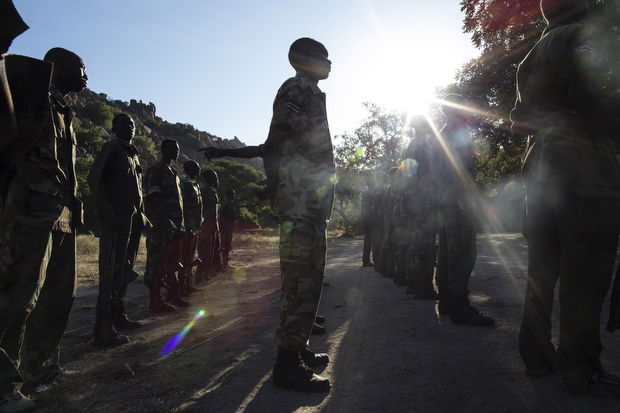
As most tragedies do, the news of Camille Lepage’s death throbbed on my newsfeed for the briefest of moments. There were a few links to the NYT obituary; a sad face, because emotions can be reduced now to punctuation parts, welcome to the 21st century; and a link to what is now probably her most lasting legacy — her photographs.
Camille Lepage, for those unfamiliar, was a French photojournalist whose body of work came primarily from the Sudan and the Central African Republic, where her lens captured fashion shows and bloodstained clothing, of citizens and soldiers and faces where you can’t tell the difference. Her body was found last week in the back of a truck driven by “anti-balaka” soldiers; hers is the first death of a Western journalist in the conflict in the CAR. She was 26.
Here’s the thing about Camille — I once thought that I would be like her. Ever since seeing Hotel Rwanda in ninth grade, I’ve wanted to be in the thick of things, as an aid worker or peacekeeper or journalist. I took French because I wanted to go into the Peace Corps; I wanted to go into the Peace Corps because I wanted to bring peace; and I wanted to go to Africa with the Peace Corps, to Francophone nations, because many of them are the ones that need peace the most. It was an uninformed viewpoint, and an arrogant one, but even still it still has allure for me, though for different reasons. Camille Lepage focused her work on stories that weren’t covered by the mainstream media; she took photographs for the Human Rights Watch, Mercy Corps and Amnesty International; she said in an interview that “I can’t accept that people’s tragedies are silenced simply because no one can make money out of them. I decided to do it myself, and bring some light to them no matter what.”

This is admirable, vital, critical. Her photographs are by turns raw and beautiful, sometimes at the same time. The world needs these narratives.
But what bothers me about this idea, especially when considering my own future, is whose job it is to tell that narrative. These are widely ignored stories of horror, these are images that we should see — but for what? A call to action? A reminder that humans are capable of such atrocity? Do these photos spur members of the UN to send peacekeepers into the CAR, do they call Mercy Corps to bring in bandages — or do they feed again into this Western narrative of a wild and dangerous continent? Few of Lepage’s subjects are named, for various reasons, including safety. But their anonymity somehow generalizes them. Nameless women weep over their nameless lost son, but it is only for us, the Western audience, that their story is confined to this snapshot. This is bleeding Africa, Africa the backwards country. This shocks us, but does not surprise us.
People much closer to this issue and journalists of repute have wrestled with these questions, I know; it has to do with the fine line between being objective and being voyeuristic. I don’t pretend to have any wise insights. But this is also what I wrestle with in my decision to join the Peace Corps. As Fadoua at URACA told me, this isn’t the right time for a blonde blue-eyed white girl to be, as I wanted to be, in the thick of things. And I have learned with certainty, while working in many communities that weren’t my own, that no sustainable change is made without the community itself as the driving force. It’s not right for the world to see that community through my tinted eyes. It’s the community itself that should write the narrative. Yet it takes a Westerner for us to pay attention to the story.
There’s an episode of Lie to Me (surprisingly great show) that revolves around an Ugandan woman’s story about being abducted by rebels and forced to participate in massacres. It’s determined, at the end, that her story is a lie — but as she spits, the only false thing about it was that it didn’t happen to her. It had happened to thousands of people, but because she was Western-educated, she was the only one anyone would listen to.
Camille Lepage was brave, and is mourned. I would like to be brave like that. I would like to use whatever talents or privilege that I have to give voices to the voiceless. But I don’t want to replace their voices with mine. So there, perhaps, is the eternal struggle of trying to translate someone else’s life — how do you work as an amplifier? How do you tell the story of a country’s struggle without de-individualizing pain?
Camille Lepage’s photographs are here. I urge you to look at them, and remember not only a remarkable woman, but the many people she photographed, whose deaths count just as much as hers.
 Emily Wolfteich