
Every day at around noon, the bell on the church tower five houses away from mine chimes, regally, elegantly, comfortingly. Every morning I get up and make myself a huge cup of instant coffee, not because I need the caffeine (for all the nothing I have to do), and I eat a bruised apple because it was my brilliant idea to bury the whole bag under all my other groceries, and I sit at my spot in the window and read Amélie Nothomb’s first novel, Hygiène de l’assassin, and maybe contemplate lunch.
Every day at around 12:15, the church bells go absolutely crazy for no apparent reason, chiming absolutely no hour but possibly letting us know that the British are coming. The main road that goes just in front of my house also goes crazy, everyone desperate to get home – after all, there’s only two hours for lunch, o the inhumanity – and, from time to time, the gravel crackles as someone rips down the road beside my window. The church bells keep going, not understanding why we’re all not running for the craggy hills. The dog across the street barks. I make another cup of coffee. It smells like honeysuckle.

My entrance to Clamecy, a town of about 5,000 people (and almost exactly the same size as my alma mater, square footage and all) was not particularly auspicious. Fresh off a heady week in Paris, visiting friends and eating a lot of food and encountering all the types that I had missed, I discovered that when SNCF tells me that there’s a connection I have to make in a town called Cravant, it’s actually from a train into a small white van, with a completely unintelligible driver, who was probably making fun of me the whole time and kept asking me why I had so many bags. Apparently he simply didn’t accept my premise that I was moving to Clamecy. Neither did approximately 40% of the other people I spoke to, including people who knew about my job. And frankly, neither could I, at first. After living in and loving big cities my entire life, there seemed very little appealing about a town where the entire size of the high school is less than half the size of my graduating class.
But so far – sans internet, and thus sans communication with the outside world – I’m really happy, happier in fact than I expected to be. My apartment, on the first floor of another teacher’s house, is about six times bigger than my apartment in Paris, with a washing machine (!!), a full kitchen (!!!) and a shower I can turn around in (!!!!!) So far, the flies and the television have been my closest friends, with dubbed-over Dr. House, a show called Les Ch’tis dans le jetset which is inexplicable but highly entertaining, and, joy of joys, Mama Mia. I have no transportation other than the occasional lift from the other teachers and my own feet, so it’s been a lot of wandering. It’s about 15 minutes to the school and another 10 minutes into the town along the main (read: only) road, which at night is not spectacular but is one of the best ways to see the town.
And the people here have been singularly kind. From my hosts, Estelle and Alexandre, and their four-year-old son who solemnly invited me for a Coke and proceeded to pour me an inch before saying “that’s enough,” to the kindly old man who has now picked me up twice on the side of the road to drive me to where I need to be, a cigarette perpetually dangling out of his mouth, to the other teachers who have invited me for drinks and been kind and welcoming, to even the man and his son walking by my window who had a friendly conversation about wine and soccer – this is not Paris.

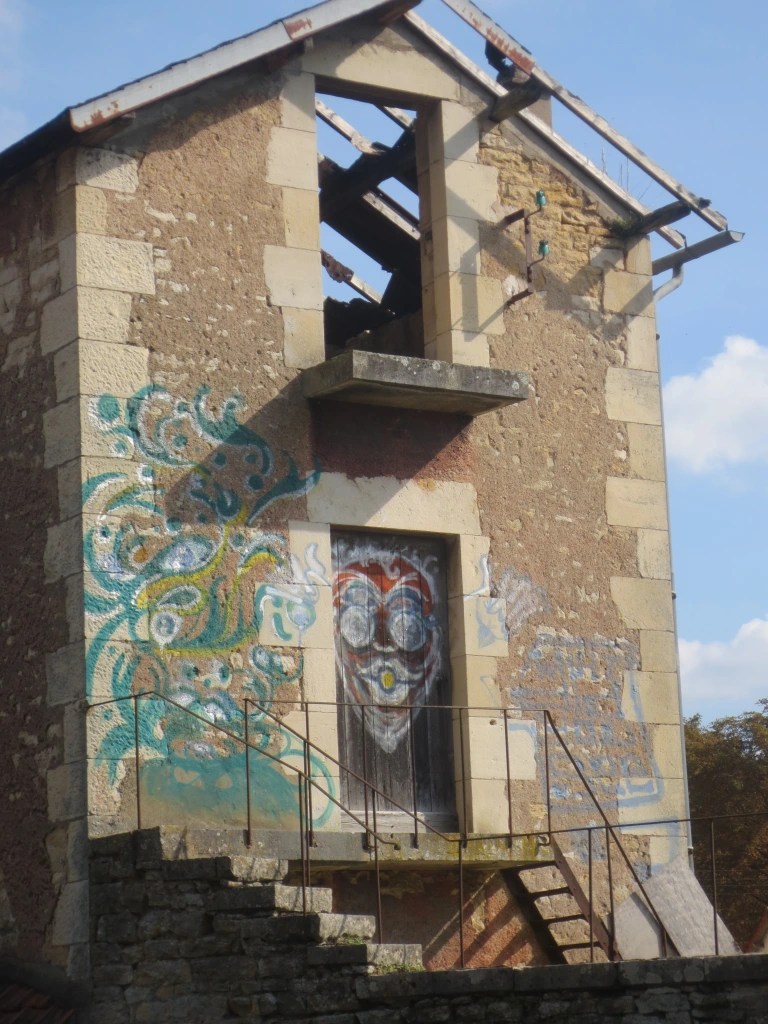
Clamecy is a very, very poor area. The unemployment rate is high and evident, especially in the mornings at the entrance to the école and in the late afternoons where groups of women and men wait for hours for their kids to exit school, and then wait a little more afterwards just because there’s nothing much else to do. The region used to be exceptionally rich. It was the center of the riverboat and logging business, sending lumber and logs by stream to all the major cities of France, including Paris, and the effects of this wealth are visible in the houses built all of stone, the cobbled streets, the soaring and intricately carved cathedral. But when the logging business left, so did most of the money, and now when I walk past some of these once-beautiful houses, the rooms inside are empty or packed with junk, and from the road the broken or missing windows look like a defeated boxer’s mouth. A lot of the work now comes from either the farms or the factories just outside of the town, trucks packed with hay bales hurtling down the road just behind eighteen-wheelers.There is something a little furrowed about this town, there is some shadow of worry etched on people’s faces.
Even some of my students’ faces, even though I’ve only met them yesterday, and it’s maybe that more than anything that makes me glad to be here. I’ll be working with the European section, and more specifically with those who have chosen to focus on English. They vary by class – the terminal, or senior, class seems obviously a little more rowdy – but so far, they all seem to be actually interested in me (âllo ego boost) and, more than that, they seem interested in English. Some of them, according to my colleagues, see English as their way out of a life that doesn’t seem to offer them much else in the way of opportunities. I don’t think that, until this point, I saw this as a chance for me to really make a difference. Perhaps it’s still naïve of me to think that. But I think there’s a shot.
And other than that, I’m just trying to take advantage of everything. On my third day here, I weaseled my way aboard a hotel-boat docked in the canal for a Diet Coke and a look-see, and returned that night to spend a joyful evening with the crew—Cisco the vibrant Chilean captain who insisted that I share in their wine stock and, before we’d even been introduced, did a catwalk down the path with his new Armani suit jackets he’d just bought in Paris for 10euro; Mark the Scottish cook, who after almost six months aboard this boat in France had picked up about five phrases of French and kept throwing them into conversation regardless of their relevance, and who made me laugh til my sides hurt for the first time since arriving back in France; Noemie the girl from Dijon with one of the best smiles I’ve ever seen, who called me to make sure I was coming back; Tom the proper Manchesterian deckhand who reportedly is singlehandedly keeping the tea industry plush, and who fakes comprehension of French superbly well; and George, the tattooed too-tall-for-the-boat host with a perfect British and perfect Dijonnaise accent because he was from both places, who seriously counseled me against getting a tattoo at the local tattoo parlor. We spent an evening by the canal watching the petal-freckled water and recounting stories from their six months on board, transporting rich Anglophones from Auxerre to Clamecy and back. They, too, couldn’t believe that I was staying here.
But in the late afternoons I can sit on a pillow in my window with a cup of tea or a glass of French red wine, which I missed, and watch the sun set over the trees and broken rooftops, and maybe talk to the people passing by, and think about dinner and about what I want to do here, and feel very content. There’s chances to do some really cool things here, and I want to make sure I don’t miss any of them. It smells like woodsmoke, and there are dozens of stars.

 Emily Wolfteich